











Historical Matchup: Two Tommies and a Grease Gun in .45 ACP
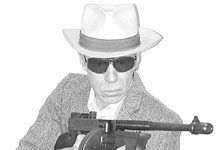
The Tommy gun first carved a name for itself on the streets of Chicago during the grand bad days of the "Roaring Twenties," and later played an important part in several world conflicts. The term "Chicago Typewriter" is only one of many applied to what was, for some, an excellent fighting tool. First placed on the market in 1921, Gen. John T. Thompson's remarkable invention quickly found its way into lawless hands, most likely led — or at least inspired — by Chicago's bootleggers. Only later, when police forces realized their lack of comparable firepower, did law enforcement adopt the weapon.
One of the earliest marketers of the Tommy gun was the Auto Ordnance Corp., same name as the makers of two of our test guns. The first price noted was $200, quite a handful of change in the early 1920s. However, if you wanted a submachinegun at that time, there were exactly no other options worldwide until about 1928, according to Smith's "Small Arms of the World." The Tommy gun thrived.
The first editions of the Thompson were marvels of careful machining. These were the guns with the slotted bolt knob on top (so you could see the sights), the double pistol grip, the 50- or 100-round drum magazines, and with cooling fins cut around the rear portion of the barrel. The early Tommy guns also incorporated a friction-type mechanism (Blish theory) that was supposed to delay the blowback operation, though later tests indicated little actual delay took place, and the system was eventually dropped. The early guns also had the Cutts compensator, designed to help control muzzle climb in full-auto mode. These guns had hand-detachable butt stocks and an adjustable leaf-type rear sight. These came to be known as the Model 1928A1. Caliber was, of course, .45 ACP, but some were also produced in 9mm and 38 Auto.

.45-70 Single-Shot Rifles: Can Ruger, Browning Outdo Shiloh?
Back in February of this year we tested a group of Sharps rifles by Shiloh, Cabela's and Cimarron. We found that although the other two versions were nice, we felt the price and several-years' wait necessary for the Shiloh Sharps were well justified, because it was the nicest Sharps rifle of the bunch. But can you get a good .45-70 single shot that's not a Sharps, and would you want to? Let's find out.
We obtained a nearly new Ruger No. 1S and a brand-new Browning 1885, both in .45-70, to test against our previous best single-shot, the Shiloh Sharps. These two rifles, while contemporary, both resemble — at least slightly — older rifles from the time of the Sharps. They were not precise copies of earlier rifles, though the Browning came close. We wanted to see how well they'd hold up to the Shiloh Sharps's quality, and to see if they were better buys for you, the lover of single shot .45-70s.
The two newer guns had a tough opponent in the Shiloh, as we noted in the February 2001 issue. The feel of the Shiloh's action was like that of a fine watch. It opened with precision, and shut like the old bank-vault door. There were no machining marks visible anywhere. The inletting was perfection. The sights could be whatever you wanted them to be and agreed to pay for, except (as far as we could tell) there were no provisions for modern scope mounting. Accuracy with the costly aperture sights that were fitted on our test sample was all we could hold for in the dismal light conditions in which we tested this rifle. The better we could see and hold and squeeze, the tighter were our groups.
This was the standard against which we gauged the Browning and the Ruger's performances. How did they do? Read on to find out:

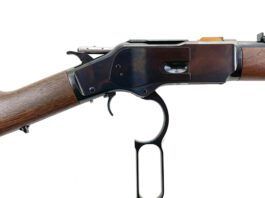
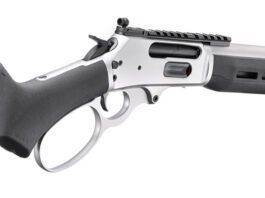
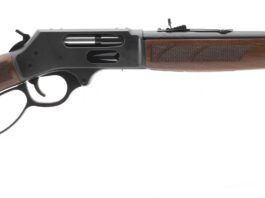
.45 LC Lever-Action Guns: Saddle Up With Cabelas, Cimarron
Cabela's gorgeous Henry and Cimarron's 1873 are cowboy-ready, but not so Winchester's 94AE—still, the latter does have its uses.
Marlin Model 1894 Cowboy Our Pick Of .45 LC Cowboy Rifles
The S.A.S.S. eventually begat Cowboy Action Shooting, and the rest is history in the making. No other shooting sport is growing as fast. It got a foothold in California, moved into Arizona, then Texas, is presently spreading rapidly through Florida, Pennsylvania, Georgia and doubling the number of active participants nationwide every 12-1...